Grok-2 Image Gen
Grok-2-Image is multimodal AI model, combining vision and language processing. It can analyze images, generate text descriptions, answer visual questions, and even assist in automated content creation.

What Is Grok-2-Image?
Unlike text-only models, Grok-2-Image bridges the gap between visual and textual data, making it ideal for:
| Industry | Use Case | Benefit |
|---|---|---|
| E-commerce | Automated product tagging | Faster catalog updates |
| Healthcare | X-ray & MRI analysis | Reduced diagnosis time |
| Marketing | Ad image optimization | Higher engagement rates |
| Manufacturing | Quality control automation | Fewer defective products |
| Security | Surveillance anomaly detection | Improved threat identification |
Key Features of Grok-2-Image
Use cases
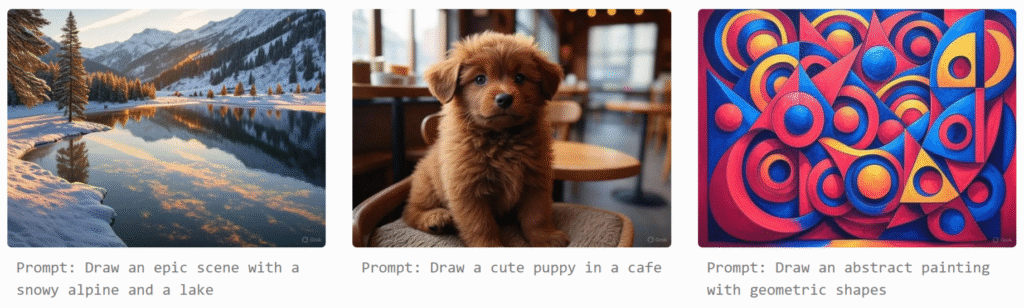
The photo shows examples of prompts and their results obtained using the Grok-2-Image model.
Getting Started with Grok-2-Image
Step-by-Step Setup:
- Check xAI’s official release.
- Sign up for API access (if required).
- Test with sample images to validate performance.
- Deploy in your workflow (cloud, on-premise, or edge).
For Developers: Powerful API and Seamless Integration
Grok-2-Image offers a developer-first API with support for Python, JavaScript, and RESTful endpoints. Its token-efficient processing keeps costs low while delivering high accuracy.
- Pre-trained vision models for object detection, OCR, and scene understanding
- IDE-friendly SDKs for VS Code, PyCharm, and Jupyter
- Batch processing for handling large image datasets
- Webhook support for real-time analysis
| Feature | Performance |
|---|---|
| Image Processing | <500ms latency (95th %ile) |
| Max Resolution | 4K with smart compression |
| API Quota (Free Tier) | 1,000 images/day |
| Supported Formats | JPG, PNG, PDF, TIFF |
The model’s quantized weights allow local testing on consumer GPUs, while cloud deployment scales effortlessly.
How Developers Can Use Grok-2-Image
Accessing the API: Once available, developers can integrate Grok-2-Image via: REST API (Python, JavaScript, etc.); Official SDKs (if released); Self-hosting (if open-sourced); Example API Call (Python).
import requests

api_key = "YOUR_API_KEY"
url = "https://api.x.ai/grok-2-image/v1/analyze"

headers = {"Authorization": f"Bearer {api_key}"}
data = {"image_url": "https://example.com/image.jpg", "task": "describe"}

response = requests.post(url, headers=headers, json=data)
print(response.json())
Fine-Tuning for Custom Use Cases: Businesses can train Grok-2-Image on proprietary datasets for brand-specific image recognition, specialized medical diagnostics and industrial defect detection.
For Companies: AI That Transforms Visual Data into Value
Businesses use Grok-2-Image to automate workflows, enhance customer experiences, and extract insights from visual content.
Proven Use Cases:
- E-commerce sites boost conversions by 22% with auto-tagged product images
- News agencies cut editorial time by 40% with AI-powered photo sorting
- Healthcare providers reduce diagnostic errors through enhanced scan analysis
- Retailers prevent shelf stockouts with real-time inventory monitoring
Why Enterprises Choose Grok-2-Image: Regulatory-ready (HIPAA/GDPR compliant modules); White-label options for customer-facing applications; Dedicated SLAs for mission-critical deployments.
Comparison between model variants
The Grok-2-Image model may offer specialized variants like grok-2-image-fast, optimized for latency-sensitive applications with faster infrastructure while maintaining the same underlying model architecture. These performance-optimized versions trade off some response quality for significantly improved response times, ideal for real-time visual processing.
For cost-conscious implementations, a potential grok-2-image-mini variant could provide reduced cost operations with slightly constrained capabilities. Developers should evaluate whether their use case prioritizes speed (fast variants) or detail accuracy (full-featured versions) when selecting the appropriate model configuration.
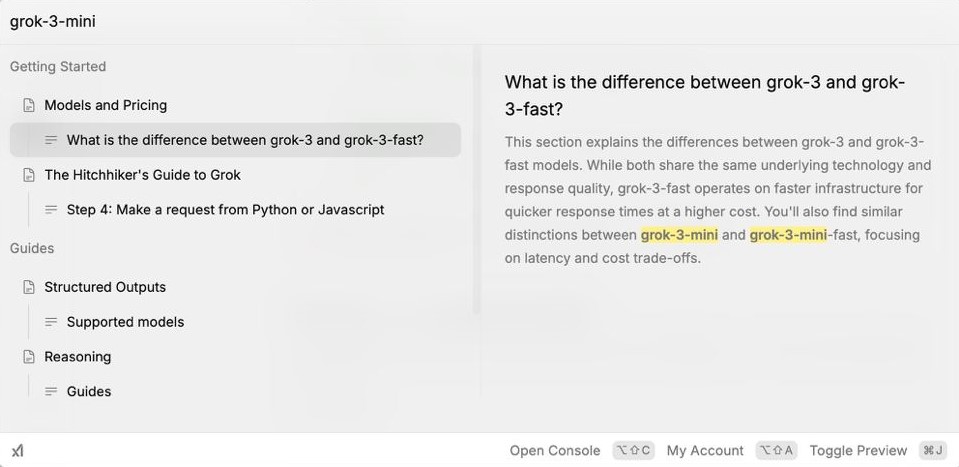
The situation is similar with other models: for cost-sensitive deployments, Grok-3-mini-fast offers a balanced alternative, reducing operational expenses while maintaining acceptable performance. Developers should choose based on priorities: speed (Grok-3-Fast) or accuracy (Grok-3).
Why Grok-2-Image Stands Out
Compared to GPT-4 Vision and Gemini, Grok-2-Image offers tighter integration with X (Twitter) data, Elon Musk’s focus on real-world AI utility and potential open-weight release (like Grok-1).
Unlike generic vision APIs, Grok-2-Image understands context between images and text. Its hybrid architecture delivers 92% accuracy on industry benchmarks while using 30% fewer resources than competitors (https://docs.x.ai/docs/guides/image-generations).
The Grok-2-Image model may be referenced under different aliases like grok-2-image-latest to indicate the most current stable version. These naming conventions enable automatic migration to updated iterations while maintaining backward compatibility. By using standardized model aliases, developers can seamlessly access latest features like improved visual recognition without manual version tracking.
This system is particularly valuable for teams deploying computer vision solutions at scale. Whether through APIs or local deployments, the alias structure ensures consistent model access across different platforms and services while simplifying version management in production environments.
Different versions of Grok-2-Image offer varying input capabilities, from basic image classification to complex multimodal prompts combining text and visuals. Newer iterations might support higher-resolution inputs or specialized domains like medical imaging. These enhancements directly impact the model’s applicability across industries.
The output capabilities similarly evolve between versions, with improvements in caption accuracy, visual question answering, or generated image edits. A production-grade version could offer deterministic outputs for mission-critical tasks, while a research variant might prioritize creative flexibility. Understanding these distinctions helps businesses select the optimal version for their visual AI needs.